Test first, then talk price
Asbestos Abatement Done by the Book in Georgetown
The short version: if your home predates roughly 1990 and you are renovating, repairing damage or disturbing old materials, test before you cut. We coordinate independent lab testing, then handle asbestos abatement under Ontario's rules: containment, controlled removal and licensed disposal. Small projects commonly run $500 to $2,000, mid-size $1,500 to $5,000. Call (437) 475-8501 before the sledgehammer comes out.
Where asbestos hides in older Georgetown homes
Georgetown's housing stock is old enough that asbestos is a routine finding, not a rarity. The century homes downtown and the Delrex streets from the 1950s and 1960s were built and renovated straight through the decades when asbestos was in everything: plaster and drywall joint compound, 9-inch vinyl floor tiles and their black mastic, pipe and duct insulation, cement board around old furnaces, textured ceilings, and vermiculite attic insulation. None of it is identifiable by eye. The grey pipe wrap in your basement might be harmless fibreglass or might not, and the only difference that matters comes from a lab report.
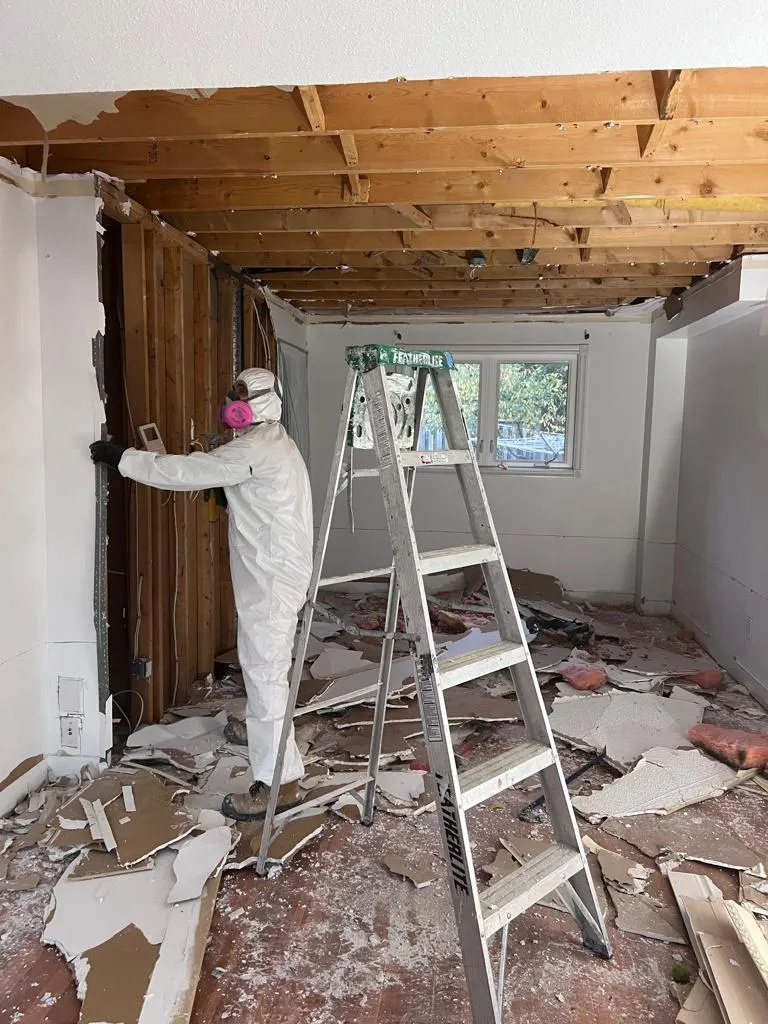
This is why asbestos work and renovation collide so often here. The moment you open a wall in a pre-1980 house, you are potentially in asbestos territory, and the same is true when we open walls for flood or mold work, which is how this service ended up on our truck in the first place.
A rough dating guide for suspect materials
Lab tests decide, but era narrows the search. Homes built or renovated up to the 1960s: plaster systems, pipe and boiler insulation, and cement-asbestos products are the classic finds. The 1960s through early 1980s, which covers the Delrex build-out: drywall joint compound, textured ceilings, 9-inch floor tiles and sheet-flooring backing, and vermiculite attic insulation. Even into the late 1980s, some stockpiled materials kept being installed, which is why we use 1990 as the practical screening line rather than the earlier dates people expect. A house that has been renovated three times can contain materials from every one of those eras in the same wall cavity.
The rules: Ontario Regulation 278/05, in plain language
Asbestos work in Ontario is governed byO. Reg. 278/05 under the Occupational Health and Safety Act, and the province publishes aplain-language guide to it that any homeowner can read. Material counts as asbestos-containing at 0.5% asbestos by dry weight, and every job is classified as a Type 1, 2 or 3 operation by risk. Type 1 covers low-risk work like removing intact non-friable material. Type 2 covers medium-risk work and brings enclosures, respirators and decontamination procedures. Type 3, high-risk work such as removing friable insulation, requires full enclosures, air monitoring and advance notification to the Ministry of Labour. The classification is not a contractor's opinion; it follows from what the material is and how it must be handled, and it drives the precautions, the timeline and the price. When we quote, the quote names the type and what that type legally requires, so you can check our work against the regulation yourself.
How an abatement runs
1. Independent testing. Samples go to an accredited lab through a third-party assessor. We do not grade our own homework, on mold or on asbestos.
2. Scope and classification. You get a written scope naming the material, the operation type, the precautions and the price.
3. Containment and removal. Sealed work area sized to the classification, wetted material, controlled removal, sealed and labelled waste bags, HEPA cleanup of the work area.
4. Disposal and documentation. Waste travels to a landfill licensed for asbestos, and the paper trail, test results, scope, disposal records, stays with you. It matters at resale, and it protects you if a future contractor asks what is in the walls.
What does asbestos removal cost?
Testing through an independent firm typically runs $300 to $600. Type 1 removals, an intact tile floor in one room, cement board panels, commonly run $500 to $2,000. Type 2 scopes such as drywall with contaminated joint compound or pipe-wrap sections generally land between $1,500 and $5,000. Type 3 work is quoted per project because enclosure and monitoring dominate the cost. Every quote states its assumptions, and none of it starts without a lab result in hand.
Found during a mold or flood job? Common, and handled
A wet basement in a 1960s house regularly turns into two projects at once: the water or mold, and the asbestos in the materials that must come out. Since containment discipline is the shared skill, we fold the abatement into the same project plan rather than sending you to a second contractor mid-crisis. The overlap runs both ways: our mold remediation, often uncovered in the same renovation, uses the same containment-and-clearance logic, and both trades earn their keep in Georgetown's older housing stock more than anywhere else we work.
Asbestos questions, answered straight
Is asbestos dangerous if I just leave it alone?
Intact, undisturbed asbestos-containing material is generally considered low risk; the hazard is fibre release, and fibres release when material is cut, sanded, broken or badly deteriorated. The practical rule: know where it is, leave it sealed and undisturbed, and deal with it professionally when renovation or damage means it will be disturbed. What you should never do is scrape, drill or demo it casually.
How do I know if my house has asbestos?
Age is the screen: homes built or renovated before roughly 1990 can contain it, and the only way to know for sure is lab testing of a sample. You cannot identify asbestos by looking at it, and neither can we, which is why testing comes before any quote. Sampling and lab analysis typically runs $300 to $600 through an independent firm.
Can I remove asbestos from my own house legally?
Ontario’s occupational rules govern workers rather than homeowners working alone in their own homes, so a homeowner DIY removal is not the same legal situation as hiring workers. Legal is not the same as wise: without containment, negative air and proper disposal you can contaminate the whole house and expose your family for years. Our honest advice is to test first and let the classification decide, and never to DIY friable material.
What happens to the asbestos after you remove it?
It leaves in sealed, labelled bags and goes to a landfill licensed to accept asbestos waste, with disposal documentation you keep. It does not go in a rented bin with the rest of the reno debris, and any contractor vague on this point is telling you something important about the rest of their process.
Do you deal with vermiculite attic insulation?
Yes, and it deserves its own caution. Loose vermiculite from the relevant decades can contain asbestos, it cannot be judged by eye, and disturbing it, including for pot lights, bathroom fans or air sealing, releases whatever is in it. We arrange sampling first; if it tests positive the removal is a full-containment vacuum extraction job, not a shovel-and-bags weekend. Do not let any trade work in a vermiculite attic before the lab result exists.
My reno contractor found suspicious material mid-job. Now what?
Stop work in that area, close the door, and get the material sampled. This is common, not catastrophic: joint compound, floor tile and pipe wrap turn up constantly in houses of that age. If it tests positive we scope the abatement, do the removal under containment, and your renovation resumes on a clean, documented substrate, usually within days for typical scopes.